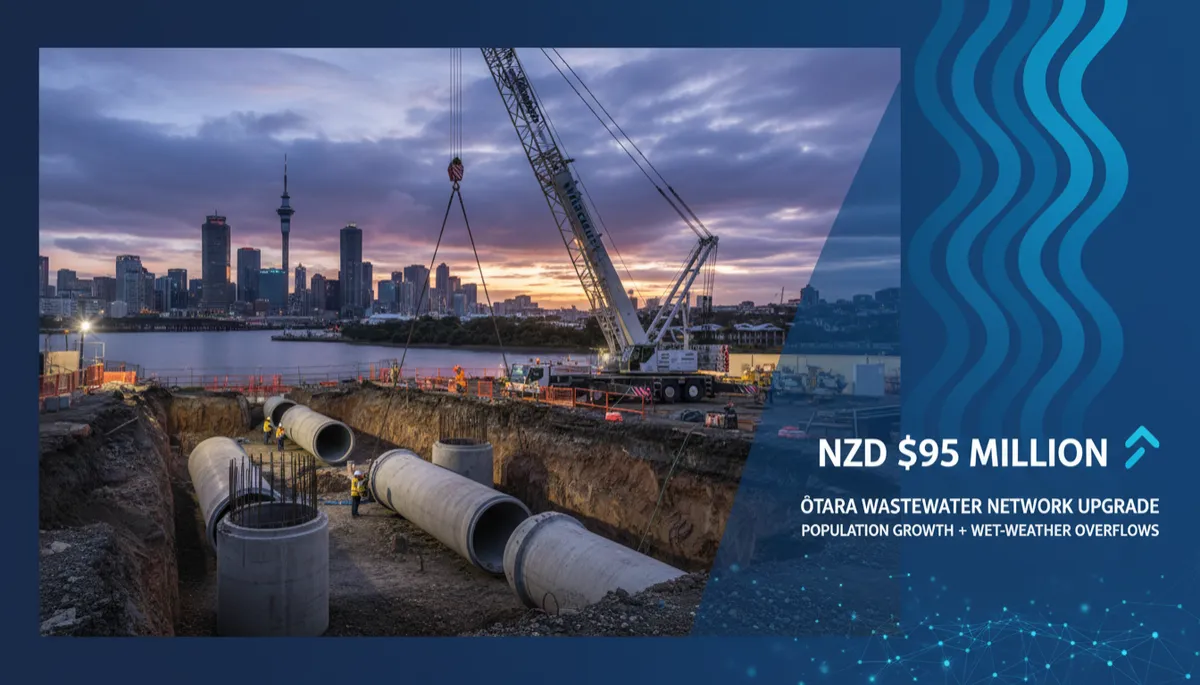
Watercare's $95M Ōtara Wastewater Upgrade
Construction industry news, Watercare, Auckland infrastructure, NZ construction 2026
Watercare commits $95m to Ōtara wastewater upgrade as NZ construction enters reset phase
Watercare’s newly announced NZ$95 million investment in the Ōtara wastewater network marks one of Auckland’s most significant local infrastructure commitments for 2026, with major implications for civil contractors, engineers, and project consultants across New Zealand and Australia.
Addressing Ōtara’s capacity crunch and wet-weather overflows
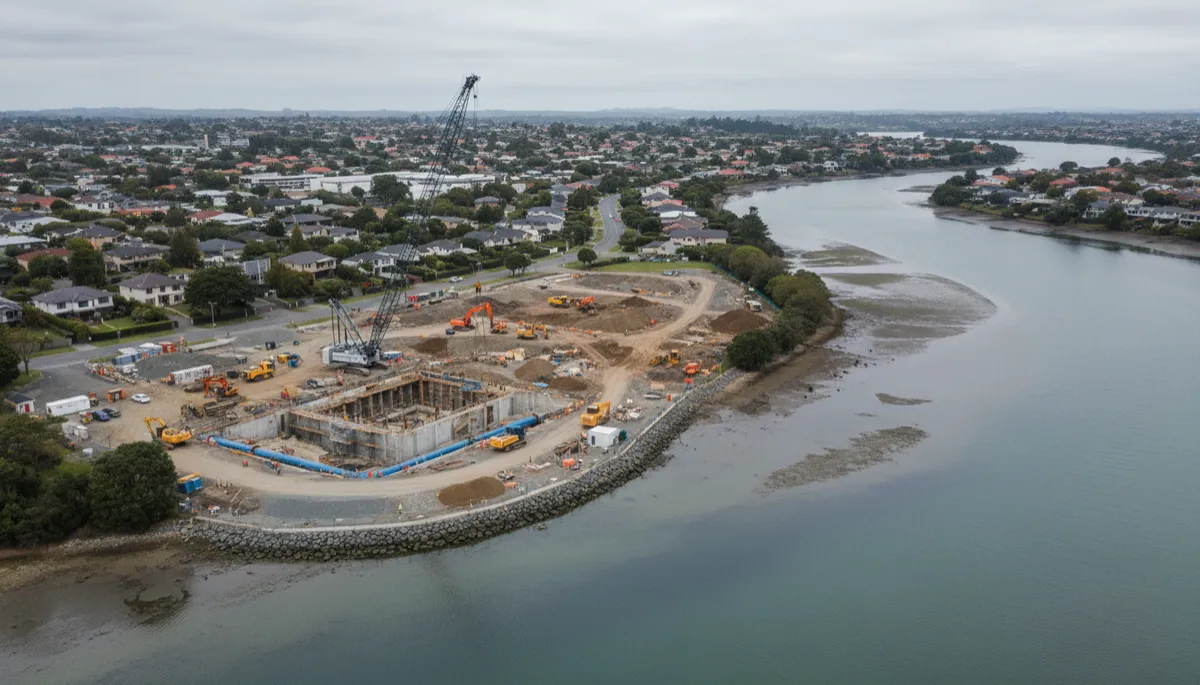
Announced on 16 September 2026, the Ōtara wastewater upgrade responds to mounting pressure on a network that has been steadily reaching capacity due to rapid population growth and intensification in South Auckland. As greenfield subdivisions and brownfield redevelopments come online, the existing wastewater system is increasingly constrained, particularly during storm events when inflow and infiltration spike volumes across the catchment.
During heavy rainfall, the current network can overflow into local streams and ultimately the Tāmaki River, undermining water quality and putting pressure on already sensitive urban waterways. Watercare’s $95 million Otara wastewater upgrade is designed to both support Auckland’s continued population growth and significantly reduce these wet-weather overflows into the environment, streams, and the Tāmaki River (Watercare, 2026). The project also aligns with broader regional efforts following the Central Interceptor’s commissioning to lift wastewater performance across the city.
Project scope: new pump station, pipelines, and underground storage
At the heart of the scheme is a new pump station and strategic reconfiguration of flows across the southern catchment. Watercare will construct a new pump station at Hannah Road and install new pipelines to pump wastewater northward from the southern catchment area, bypassing the rest of the Ōtara catchment. By diverting these flows, the project frees up capacity in the existing network and reduces the risk of surcharge and overflow during peak events.
Additional underground storage at Billington Reserve, where the existing Ōtara pump station is located, is another critical element. Seven underground storage tanks are planned to provide significant buffer volume during heavy rain, temporarily holding peak wet-weather flows before they are pumped forward once network capacity is available. This storage is expected to materially cut the frequency and volume of overflows to nearby streams and the Tāmaki River, improving environmental outcomes for downstream communities and ecosystems.
Investigation works are scheduled to begin in late September 2026 and are expected to take around three months, covering geotechnical investigations, services locating, and constructability assessments. For consultants and contractors, this early phase will shape methodology decisions, including trenchless versus open-trench sections, traffic management approaches, and community disruption mitigation across residential streets and reserve land.
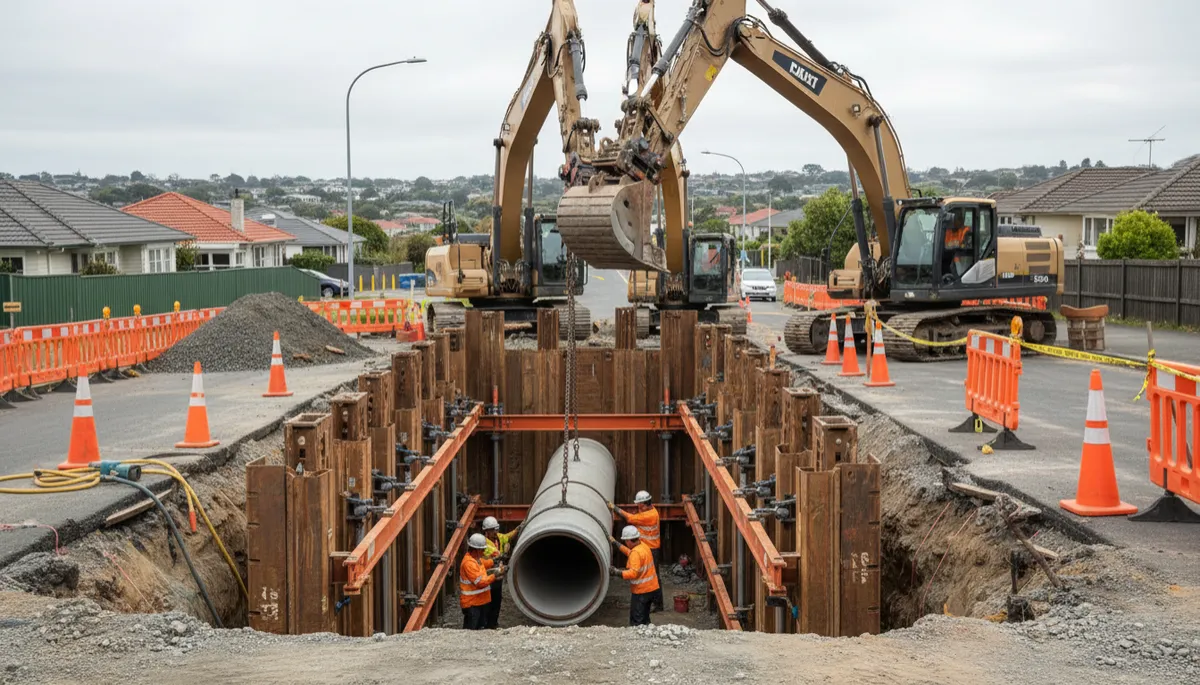
Deep pipeline works and storage assets will demand careful staging, traffic management, and community engagement.
Engineering significance within Watercare’s $15.2b capital programme
The Ōtara upgrade is one of more than 1,000 projects within Watercare’s 10‑year, $15.2 billion capital investment programme, which is reshaping Auckland’s water and wastewater infrastructure at scale (Watercare, 2026). While the Central Interceptor and other marquee projects have captured national headlines, localised network upgrades like Ōtara are where many engineering and construction firms will see steady, technically interesting work over the coming years.
For designers, the scheme highlights several current themes in wastewater engineering: maximising use of existing corridors, integrating storage to manage climate‑driven rainfall variability, and sequencing works to maintain service continuity. The combination of a new pump station, rerouted flows, and storage at Billington Reserve reflects a systems approach rather than a simple like‑for‑like capacity increase, which will appeal to firms with strong hydraulic modelling and network optimisation capability.
NZ construction 2026: reset, digitisation, and labour constraints
The announcement lands as New Zealand’s construction sector moves through a clear reset phase in 2026. After several years of volatility, forward work in civil infrastructure is strengthening, particularly in water, transport, and resilience projects ahead of the national election. For many contractors, infrastructure is helping offset softness in some vertical markets.
At the same time, structural challenges persist. Labour shortages remain a defining constraint, especially for experienced supervisors, project managers, and specialist operators. This will shape delivery strategies on the Otara wastewater upgrade, with joint ventures, alliance-style arrangements, and increased use of prefabrication and off-site assembly likely to feature as firms look to de‑risk programmes and maintain productivity.
Digitisation is another major undercurrent. eInvoicing adoption in construction has reportedly surged 854%, with 9,157 businesses now using eInvoicing platforms. This shift is being accelerated by the NZ construction eInvoicing mandate, which requires government agencies to pay 95% of domestic trade eInvoices within five business days by January 2026. From January 2027, large businesses will also be required to send eInvoices when billing government agencies. For firms chasing work on Watercare’s Auckland infrastructure pipeline, streamlined eInvoicing and faster payment cycles could provide a welcome boost to cash flow and reduce administrative overhead on complex, multi‑year contracts.
What this means for engineering and construction firms
For NZ and Australian engineering and construction professionals, the Otara wastewater upgrade is both a project opportunity and a signal of where the market is heading. Watercare’s investment confirms that wastewater networks in fast‑growing urban areas will remain a priority, with strong pipelines of work in renewals, capacity upgrades, and environmental performance improvements across Auckland and beyond.
Firms looking to position for this and similar projects should focus on three areas: demonstrable capability in complex brownfield delivery; integrated digital practices—from BIM to eInvoicing and digital QA; and robust workforce strategies that address skill shortages while maintaining safety and quality. Those able to combine technical excellence in wastewater network design and construction with efficient commercial processes will be well placed as Watercare’s $15.2 billion programme and wider Auckland infrastructure commitments continue to roll out.
As the NZ construction sector recalibrates in 2026, the Ōtara wastewater upgrade stands out as today’s top construction news story not just for its scale, but for what it represents: a long‑term, infrastructure‑led pathway to growth, resilience, and better environmental outcomes—backed by increasingly modern, digital ways of working.


