NZ Construction Sector Shows Signs of Recovery
Construction, NZ construction recovery, Industry News
Signs of Life: New Zealand's Construction Sector Shows Recovery Signals
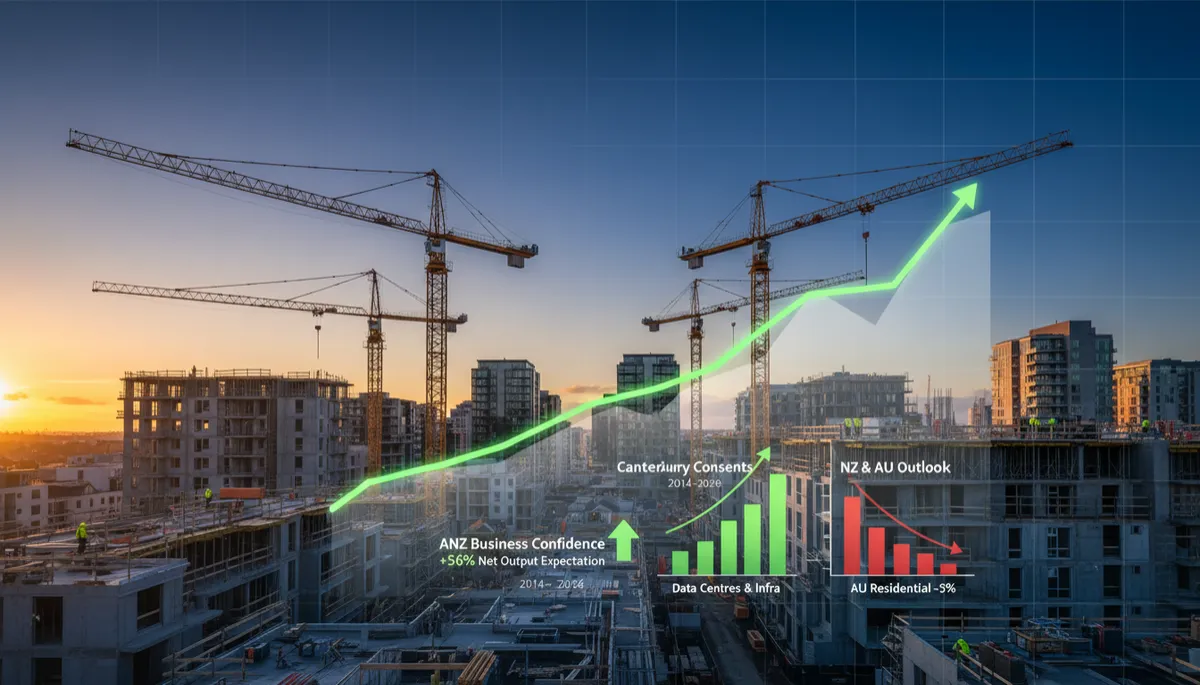
Canterbury’s residential building consents are back at levels last seen during the 2014 post-earthquake rebuild, delivering one of the clearest signals yet that New Zealand’s construction sector is edging into a new phase. For engineers, contractors, and developers across New Zealand and Australia, the latest data points to a recovery that is real—but uneven, fragile, and likely to be modest rather than spectacular.
Canterbury Consents Back at Post-Quake Highs
Latest consent figures show Canterbury hitting highs not seen since the intense 2014 post-earthquake rebuild period. Over the 12 months to late winter, the region has consented several thousand new dwellings, with multi-unit projects playing a particularly prominent role. Analysts note that Canterbury now accounts for more than one-fifth of all new dwelling consents nationally, underscoring its renewed importance in the NZ construction recovery narrative (Stats NZ; Bracen regional data).
For practitioners on the ground, the mix of stand-alone houses and higher-density developments suggests a more diversified residential pipeline than in previous cycles. While not on the same scale as the immediate post-quake surge, the current momentum is strong enough to materially support trades, consultants, and suppliers across the wider Canterbury construction ecosystem over the coming quarters.
Uneven Regional Picture: Leaders and Laggards
While Canterbury is clearly out in front, it is not alone. Central Otago and Auckland are also reporting solid growth in building consents, driven by a mix of residential intensification, lifestyle developments, and ongoing demand in key growth corridors. In these regions, forward work pipelines are again starting to resemble pre-slowdown conditions, with consultants and contractors reporting fuller order books and renewed enquiry levels for residential construction New Zealand-wide.
By contrast, parts of the central and lower North Island have yet to see much uplift. Local councils in some of these districts are still recording relatively flat consent numbers, reflecting weaker population growth, more subdued investor appetite, and tighter project financing. For firms operating nationally, this two-speed environment means resource allocation, branch strategy, and bidding decisions need to be highly selective and data-driven at a regional level.
Confidence Rebounds: ANZ Survey Shows Strong Expectations
Sentiment data is now aligning with the regional consent story. According to ANZ’s September Business Outlook survey, a net 56% of construction sector respondents expect their business output to increase over the next 12 months. That is a notably strong reading by historical standards and reinforces other evidence of early recovery in construction GDP and volumes reported in recent bank and government releases (ASB, Stats NZ).
Importantly for industry leaders, hiring and investment intentions are well above average. Firms are signalling plans to add staff, invest in plant and equipment, and, in some cases, restart deferred projects. For engineers and construction managers, this is translating into more tenders, more design briefs, and renewed competition for experienced project delivery talent—particularly in structural, civil, and building services disciplines.

Design and delivery teams are cautiously rebuilding pipelines as confidence and enquiry levels lift.
Caution Flags: Costs, Rates, and Demographics Still Bite
Despite the improving mood, economists are clear that this is not a risk-free upswing. BNZ’s chief economist has urged caution, pointing to higher construction costs, elevated interest rates, and weak population growth as ongoing headwinds for both residential and commercial delivery. Cost indices such as the Cordell Construction Cost Index show build-cost inflation re-accelerating in 2026, squeezing margins for contractors and developers alike.
Higher financing costs are also reshaping feasibility calculations. Projects that looked viable in a low-rate environment are now being reassessed, value-engineered, or quietly shelved. At the same time, slower net migration and softer household formation in some regions are dampening demand for new stock, especially at the more speculative end of the market.
Consents vs. Actual Work: A Weaker Conversion Rate
One of the more sobering features of the current cycle is that consents are not always being converted into on-the-ground activity as reliably as in the past. Industry feedback points to a growing list of developments that have been paused, staged, or scaled back in response to weaker pre-sales, tighter credit, or escalating build costs. For consultants and contractors, this can mean longer lead times between design completion, contract award, and actual site mobilisation.
Nonetheless, both bank economists and sector surveys suggest there is still enough work in the pipeline to support higher building levels over the next 6–9 months. Residential and non-residential volumes lifted solidly in Q2 2026, and forward indicators—such as orders for materials and demand for specialist trades—remain consistent with a gradual, rather than abrupt, upswing in activity.
A Modest, Managed Upturn for 2026–27
Pulling these threads together, the construction sector outlook 2026 for New Zealand is one of recovery, but not a rapid rebound. Indicators from Canterbury, central Otago, and Auckland show clear signs of life, and national surveys confirm that firms are again planning to hire, invest, and expand. Yet the combination of lingering cost pressures, higher interest rates, and patchy regional demand points to a measured, capacity-constrained upturn rather than a repeat of the last boom cycle.
For engineering and construction professionals, this environment places a premium on disciplined project selection, robust risk allocation, and close collaboration across the supply chain. Those able to price risk accurately, lock in key inputs, and maintain strong client relationships will be best positioned to benefit from the emerging NZ construction recovery without overextending balance sheets or workforces.
Australasian Context: Opportunities and Constraints Across the Ditch
Across the Tasman, Australia’s construction market is navigating its own complex mix of drivers. Data centre buildout remains strong, underpinned by cloud and AI demand, while infrastructure linked to the Brisbane 2032 Olympics is beginning to ramp up. These segments are generating significant opportunities for civil, structural, and building services specialists, and are likely to continue drawing on New Zealand expertise and labour in selected niches.
However, Australia’s residential sector is currently contracting by an estimated 3–4%, with developers facing many of the same cost and labour pressures seen in New Zealand. Capacity constraints, subcontractor availability, and escalations in materials and financing costs are common themes. For trans-Tasman firms, the broader Australasian outlook is therefore one of selective strength rather than uniform growth—demand is solid in infrastructure and specialised assets, but more subdued and margin-sensitive in mainstream housing.
In this context, New Zealand’s construction sector appears to be entering a cautiously positive phase. The recovery signals are genuine, led by Canterbury construction and other regional hotspots, but the next 12–18 months will reward firms that treat this as a period for disciplined rebuilding, not unchecked expansion.


