NZ Construction Leads eInvoicing Revolution
Industry News, eInvoicing, NZ Construction
NZ Construction Leads New Zealand’s eInvoicing Revolution
An 854% surge in eInvoicing registrations has turned New Zealand’s construction sector into the standout adopter of this critical digital infrastructure — and it’s arriving just as the industry battles soft workloads, tight margins, and chronic cashflow strain.
Construction Becomes the Standout eInvoicing Adopter
As of September 2026, 9,157 New Zealand construction businesses are registered to receive eInvoices — an 854% increase since 2023. That makes construction responsible for around 17% of all eInvoicing-registered businesses nationwide, according to data from einvoicing.govt.nz. No other sector has moved as decisively or as quickly.
Across the wider economy, 113,000 New Zealand businesses are now registered to receive eInvoices, up from about 52,000 earlier in 2026. Total eInvoices exchanged have already exceeded 1 million, signalling that digital invoicing is shifting from pilot projects to business-as-usual for many Kiwi firms.
This rapid digital transformation is unfolding against a challenging backdrop. Official figures show NZ construction activity fell 7.8% to $58.1 billion in 2024, and declined a further 4.1% to $55.7 billion in 2025. In a sector working hard to rebuild confidence and protect margins, eInvoicing is emerging as a practical, measurable way to lift productivity and stabilise cashflow.
What eInvoicing Actually Is — and How It Works on Site
At its core, eInvoicing allows businesses to send and receive invoices directly between accounting systems. Instead of printing, emailing PDFs, or manually keying in line items, invoice data travels securely over the Peppol network from one system to another, using a standardised format recognised across software platforms.
For engineers, builders, project managers and construction business owners, that means:
- A supplier raises an invoice in their accounting or ERP system (for example, for concrete, framing, or plant hire).
- The invoice is sent as an eInvoice directly to the customer’s system via the secure network — not by email.
- The recipient’s system automatically receives, validates, and pre-populates the invoice details, ready for approval and payment.
No one has to retype invoice numbers, GST amounts, or bank details. There are fewer errors, fewer disputes about what was billed, and a clear digital trail from purchase order through to payment. For site-based teams, that translates to less time chasing paperwork and more time managing programme, quality, and safety.
The Business Case: Time, Cashflow, and Fraud Reduction
New research from the New Zealand Institute of Economic Research (NZIER) quantifies what many construction finance teams already suspect. On average, businesses save at least 16 minutes per invoice processed via eInvoicing, worth around $11 per invoice in labour and overheads. When extrapolated across New Zealand’s estimated 300 million annual B2B invoices, NZIER projects up to $800 million a year in productivity gains once eInvoicing is fully adopted.
For the construction sector — where projects can generate hundreds or thousands of invoices across complex subcontractor and supplier networks — those savings scale quickly. Even a mid-sized contractor processing 1,000 invoices a month could conservatively reclaim 260 hours of admin time annually, or more than $11,000 in processing costs, simply by switching to eInvoicing.
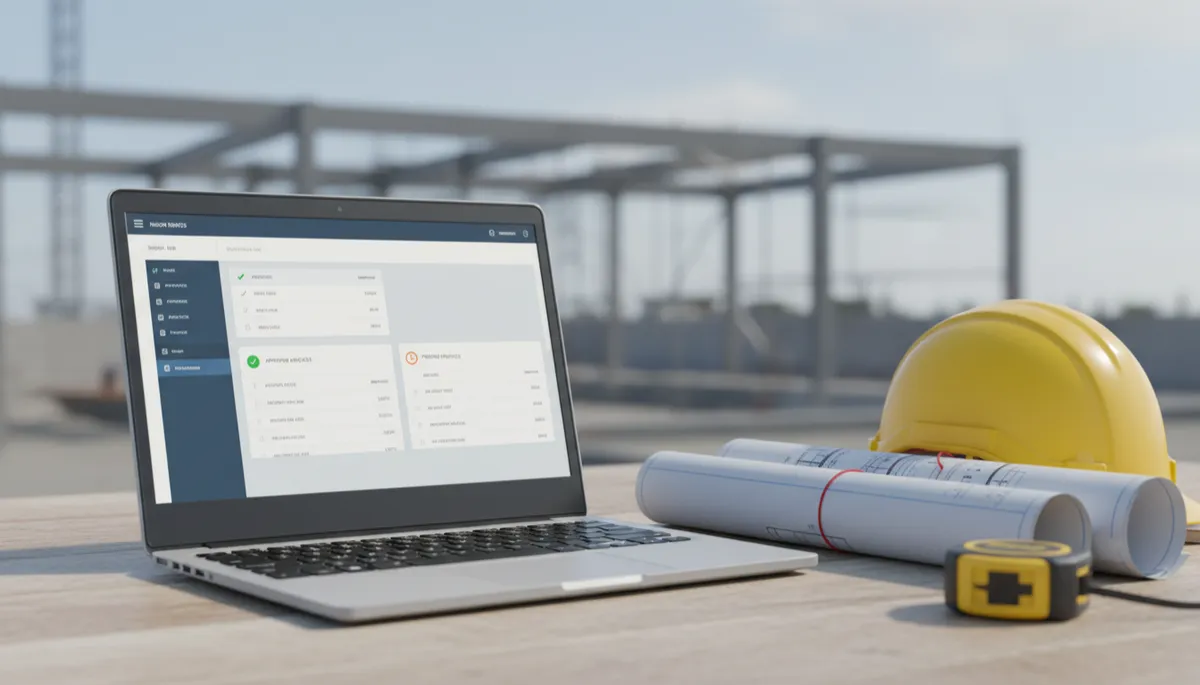
Streamlined digital invoicing frees project teams from manual data entry and chasing paperwork.
The benefits go beyond admin efficiency:
- Cashflow and speed: eInvoices reach the right system instantly, so approval workflows can start straight away. Government data shows agencies paid 95.9% of domestic invoices within 10 working days in Q1 2026, beating their 95% target. Faster processing leads directly to faster payments.
- Reduced late payments: Cashflow and late payments have been a chronic pain point for NZ construction, especially for subcontractors and SMEs at the tail of the payment chain. With fewer lost invoices and automated routing, excuses for slow payment diminish.
- Lower fraud risk: Because invoice data moves directly between verified accounting systems, there is far less opportunity for fake invoices, altered bank details, or email interception scams.
2027 Mandate: What It Means for Subcontractors and Large Firms
Policy settings are now reinforcing market momentum. From 1 January 2027, large businesses will be required to send eInvoices when billing government agencies. Crucially for the construction sector, those arrangements will also require that subcontractors are paid on terms no less favourable than large firms receive.
For head contractors and tier-one suppliers, this 2027 mandate makes eInvoicing adoption non-negotiable for government work. For smaller subcontractors, it creates a powerful lever: once a principal contractor is being paid promptly via eInvoicing, they must pass comparable payment terms downstream. Over time, this should help ease the persistent cashflow squeeze that has pushed many smaller operators to the brink in recent years.
Combined with existing rules that see many agencies paying eInvoices within five working days, the 2027 mandate positions government projects as a benchmark for payment performance. Private sector clients and developers can expect growing pressure from contractors and consultants to match these standards, especially in a market where liquidity is as important as pipeline.
Why Now Is the Moment to Get Your Construction Business Ready
With 113,000 businesses already registered, more than 1 million eInvoices exchanged, and construction accounting for 17% of all registrations, eInvoicing is no longer experimental. It is fast becoming the default expectation for professional, well-run construction businesses in New Zealand and across the Tasman.
For NZ and AU construction professionals — from consulting engineers and QS practices to builders, civil contractors, and specialist subcontractors — the next 12–18 months are the ideal window to:
- Confirm whether your accounting or ERP system already supports eInvoicing (many Xero, MYOB, and ERP users can switch on capability with minimal configuration).
- Register to receive eInvoices so key suppliers and head contractors can start sending them to you immediately.
- Map your internal approval workflows so that eInvoices move smoothly from site to finance and are not held up waiting for manual sign-off.
Call to Action: Make eInvoicing Part of Your 2027 Readiness Plan
The numbers are clear: an 854% rise in construction eInvoicing registrations, 113,000 businesses on the network, $800 million in annual productivity gains on the table, and a 2027 mandate that will make digital invoicing essential for anyone working with government agencies. In a market where total construction activity has fallen from $58.1 billion in 2024 to $55.7 billion in 2025, it is difficult to ignore a proven lever for faster payments and lower overheads.
If you are an engineer, builder, project manager, or construction business owner, now is the time to treat eInvoicing as core infrastructure — just like your project management tools, health and safety systems, and quality processes. Talk to your software provider, register your business, and start shifting key trading relationships onto eInvoicing. The sooner you move, the sooner you will see the cashflow, certainty, and construction productivity benefits flow through your projects and your balance sheet.


